New Era Of Search: What Google’s AI Search Changes Mean For Bloggers
Google I/O 2026 did not bury the lead.
AI Overviews now reach 2.5 billion people every month. AI Mode crossed 1 billion monthly users in its first year, with queries more than doubling every quarter. Last quarter, Google Search hit an all-time high in query volume.
That is the scale at which AI-generated answers are now the first thing people see.
The Blue Links Are Not Going Away
Before anything else: traditional search results are not being replaced.
Google addressed this directly after I/O. The official statement from @NewsFromGoogle: “You will absolutely continue to see blue web links in search results, and our AI features include prominent links to the web directly within responses. AI Mode is not the default experience in Search.”

So no, SEO is not dead. Google’s index still drives what gets cited in AI Overviews and what shows up in traditional results. The same content doing well in one will tend to do better in the other.
What is changing is where the attention goes first. AI Overviews sit above the blue links. They answer the question before the reader scrolls to the results. That changes how your traffic arrives, even if the underlying system is the same.
This Is Not A Future Problem
Google did not announce that AI Overviews are coming. They are already the dominant search surface for billions of users.
At I/O, Google confirmed that Gemini 3.5 Flash is now the default model powering AI Mode globally. It is fast, capable, and already answering questions for your readers before they ever click a link.
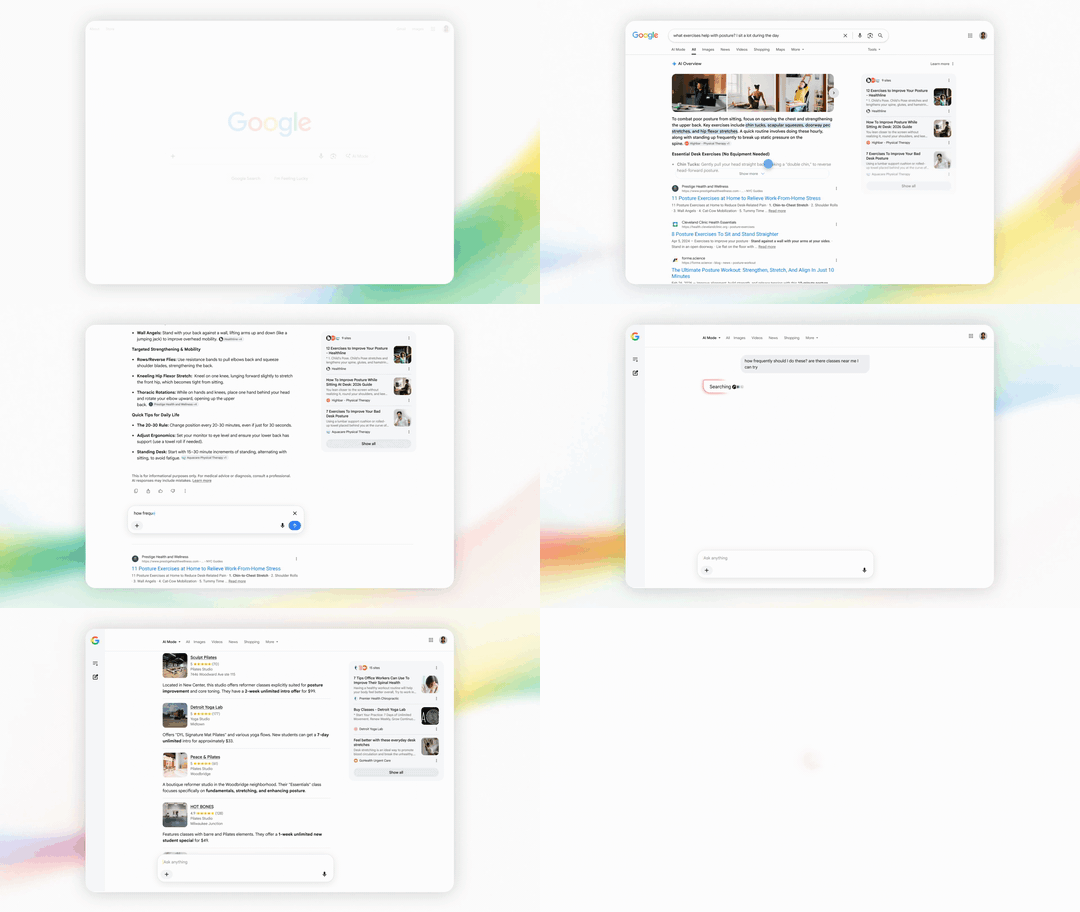
The search experience is also changing in structure. Users can now ask follow-up questions directly from an AI Overview and carry that context into a full AI Mode conversation. In Sundar Pichai’s words, Search has become “less about individual queries and feels more like an ongoing conversation.”
How People Are Actually Searching Now
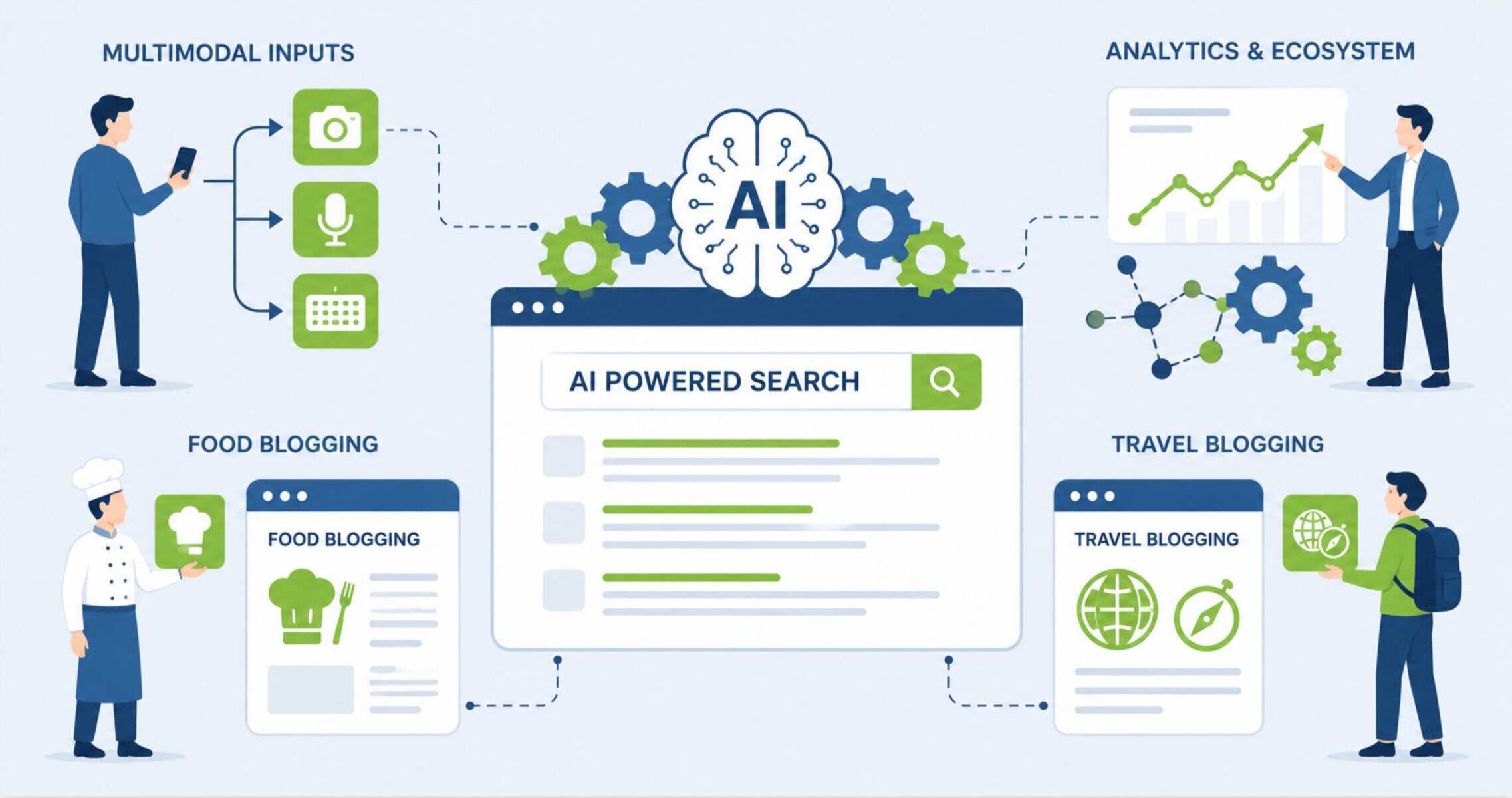
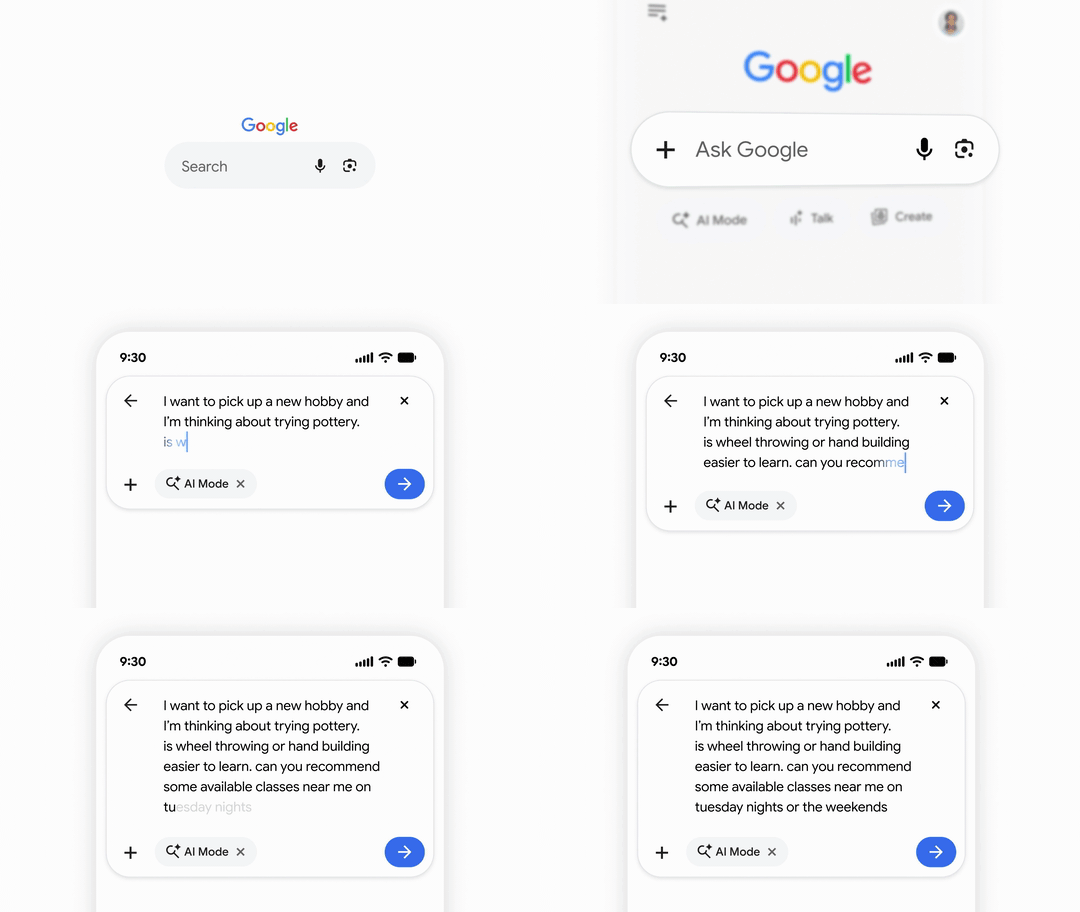
The Search box itself got its biggest upgrade in over 25 years. It now expands dynamically, accepts text, images, files, videos, and Chrome tabs as inputs, and is built for longer, more specific questions.
That changes how your readers find you.
Someone used to search: oven baked chicken thighs
Now they might ask: I have chicken thighs, garlic, yogurt, lemons, and some potatoes. What can I make tonight that’s healthy and done in under an hour?
Or they take a photo of their fridge and ask Google to give them three dinner ideas that are kid-friendly and use what they have.
For travel, it used to be: best things to do in Miami
Now it might be: I’m staying in South Beach for three days. I like architecture, seafood, and walkable neighborhoods. Build me a realistic itinerary that avoids tourist traps.
These are not keyword searches. They are tasks. And Gemini 3.5 Flash is built to complete them, pulling from indexed content, synthesizing an answer, and surfacing sources that actually help.
The question for bloggers is whether your content shows up as one of those sources, or gets summarized over.
What This Means For Bloggers and Content Creators
AI Overviews pull from Google’s index and synthesize answers. They do not just list results.
When a query has a clear, generic answer, the AIO handles it. The click goes to whoever the AIO cites, or to no one.
For food bloggers, a generic “how to bake chicken thighs” answer is exactly what an AI Overview can produce without sending anyone to your site. The same applies to travel bloggers producing standard “best things to do” lists that look identical to every other page on the topic.
The question is not whether you rank. The question is whether you get cited when the AIO is presented.
Blogs That Get Cited Have Something The AIO Does Not
An AI Overview can summarize common knowledge. It cannot replicate your specific test results, your honest opinion on what went wrong the first time, your original photo of what the dish actually looks like at the 40-minute mark, or your real take on which neighborhood is actually walkable versus just marked walkable on a map.
That is the gap AIOs fill with citations: the specific, the tested, the experienced. Google’s own guidance on AI search points to unique point of view, first-hand experience, and high-quality images and video as the content most likely to influence presence in AI search features.
Generic content does not create that gap. It closes in on it.
Get Your Blog Cited In Google’s AI Answers
Our AIO Optimizer Audit identifies the exact posts on your blog that are ranking but not appearing in Google’s AI answers. We analyze who’s getting credit instead, what they’re doing differently, and deliver small changes you need to make to close the gap. No rewrites. No new content.
Request a free AIO assessment of your content to see if the AIO Optimizer Audit is right for you.
What Food Bloggers Should Do Now
Stop treating recipes like keyword targets. The content needs to prove why this version exists and why you are a useful source for it.
That does not mean longer posts. It means more useful ones.
Add testing notes. What happened when you made it the first time. What you changed and why. Include ingredient behavior, what the butter should look like when it’s ready, and what the garlic smells like when it’s too far gone. Call out mistakes to avoid and what the fixes are.
Cover texture, timing, and temperature with specificity. “Bake until done” is summarizable. “The skin should pull away from the bone at the thigh joint and the juices should run clear, usually between 42 and 48 minutes depending on your oven” is not.
Add storage, reheating, and substitution notes you have actually tested. If you tried it with Greek yogurt instead of sour cream and it worked, say so and say how it changed the result.
These are the details Gemini 3.5 Flash will cite instead of paraphrasing.
What Travel Bloggers Should Do Now
Stop writing destination overviews. Start writing decision-support content.
Make clear who the content is for. A three-day Miami itinerary for a solo traveler who walks everywhere and eats late is a completely different piece than one for a family with young kids. Write for someone, not for everyone.
Include real logistics: how long each activity actually takes including travel time, what is worth booking ahead versus walk-in, what is genuinely overrated and why, what to do if it rains, what works without a car, what changed recently that outdated guides still get wrong.
Go neighborhood-level. “Stay in Miami” is not useful. “Stay in Wynwood if you want to walk to dinner and do not care about beach access. Stay in South Beach if you want the beach but plan on Ubering everywhere” is useful. That kind of specificity is what a reader needs to make a real decision, and it is what an AI Overview will cite.
Visuals Matter More Than They Did
Google confirmed that AI Overviews and AI Mode can surface images and videos alongside web results. Original photos and video walkthroughs are citation material now, not decoration.
For food bloggers, that means in-process shots, finished dish photos from multiple angles, and short videos showing technique. For travel bloggers, it means original location photos, neighborhood walkthroughs, and embedded video that shows what a place actually looks and feels like.
If your content only works as text, it is at a disadvantage in a multimodal search experience.
New Era Of Search
AI Overviews, powered by Gemini 3.5 Flash, are the new front page of Google for 2.5 billion people.
The bloggers who get cited are producing content Gemini cannot synthesize on its own. That means real testing, specific detail, honest opinions, and original visuals.
The ones who do not will get summarized over.

Arsen R
Founder and Managing PartnerFounder @ TopHatRank, Digital Marketer, SEO, International Speaker, SEO Coach
Read more about Arsen