Google Search in August 2026: The Changes Publishers Need to Know
We tracked, read, filtered out the noise, and reported only on search news that matters for bloggers, publishers, and content creators.

Few Words From Arsen
For Bloggers & Publishers
August 2026 gave publishers several possible reasons for traffic to move at the same time: the spam update, expanded AI Overviews, changes in Reddit, YouTube, image and video placements, and the Search Console logging issue from August 13 through August 17.
- If your traffic was affected, do not go directly to updating content. First, compare URL-level and query-level rankings from before August 18 with results after August 21. Then review the full search results page for queries where you lost clicks. If rankings held, look at what changed around your result.
- Keep your post’s format when it matches the query, but strengthen generic content with unique perspective, firsthand experience, original evidence, and a clear reason for readers to choose you as their source of information. Encourage loyal readers to select your site through Google’s Preferred Sources feature.
Now let’s dive into the important stuff that happened in search in August:
The August Spam Update Was Short and Disruptive
Google’s August 2026 spam update ran from August 18 through August 21, lasting two days and 16 hours. It applied globally and across all languages. It was Google’s third spam update of 2026, following the March and June updates.
Google did not introduce a new spam policy with the rollout or publish guidance tying it to one content-production method. As Search Engine Journal reported, Google had not said whether the update targeted attempts to manipulate generative AI responses.
Google’s existing spam policies focus on purpose and value. Scaled content abuse involves producing many pages primarily to manipulate rankings while providing little original value, regardless of how the pages were created. Generative AI is one way that can happen, but the policy also covers scraped, stitched, transformed, and human-produced content when the same conditions apply.
The first ranking-impact data showed significant disruption. SE Ranking compared the same 100,000 U.S. keywords across 20 industries immediately before and after the update, then compared those results with a five-day period in July when Google had no confirmed ranking update.
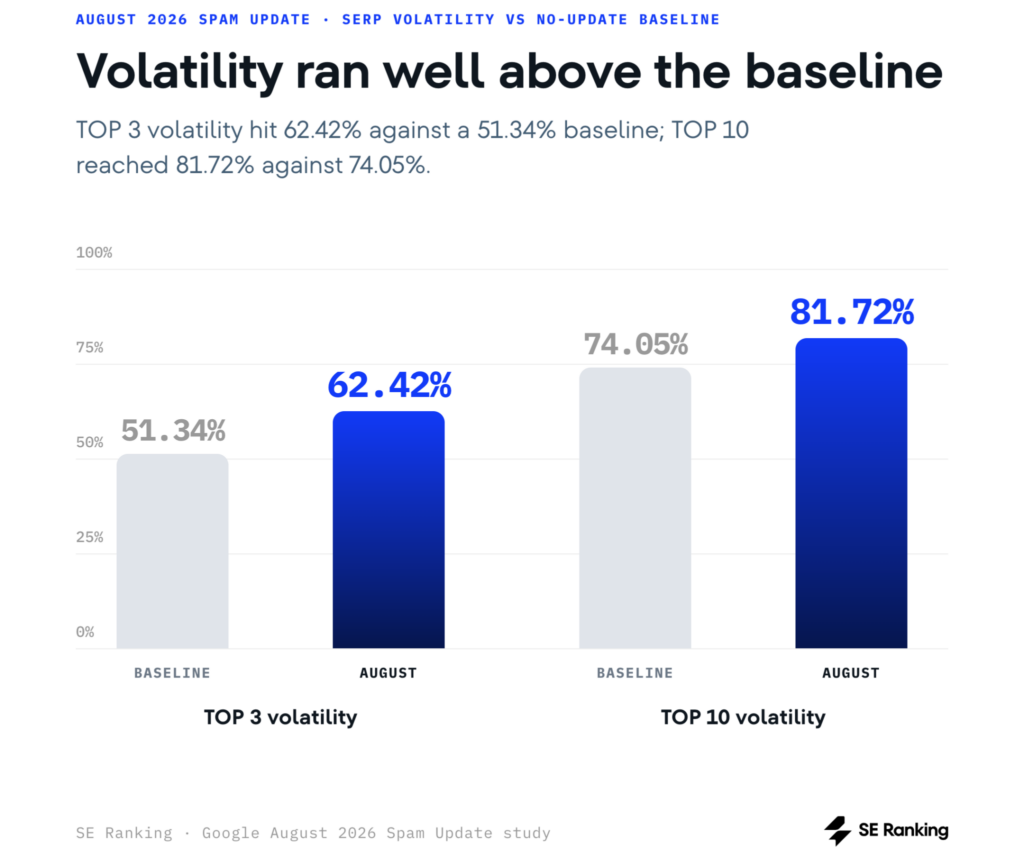
During the August update, 16.71% of URLs that had ranked in the top 10 fell beyond position 100 for the same keyword. The July baseline was 9.2%. A top-10 URL was about 1.8 times more likely to disappear from the measured top 100 during the spam update. Search Engine Land’s report also notes the limits of the dataset: it did not determine whether affected URLs were deindexed or fell below position 100, and it did not identify which site types, content types, or spam tactics were hit disproportionately.
That gives us solid evidence of unusual ranking volatility. It does not support a blanket conclusion that Google targeted bloggers, affiliate sites, or AI-assisted content as categories.
Some AI Overviews Now Expand Before the User Asks
Google confirmed on August 28 that AI Overviews may expand automatically for queries where its systems decide a longer response will be useful. Users no longer have to select “Show more” in those cases. The expanded answer can also display an “Ask anything” field that leads into a deeper AI Mode interaction.

This changes how much space an AI Overview can occupy on a standard Google results page. Traditional organic listings remain available, but they can start much farther down the page. A publisher can keep the same organic position while appearing below a larger generated answer than users saw before.
Google’s confirmation did not include traffic-impact data for this specific change, and the expanded treatment does not appear consistently for every user or query. The interface change itself is confirmed. Search Engine Land covered the rollout, and Google’s spokesperson explained that expansion stops if a user has already begun scrolling so the page does not move underneath them.
For publishers, ranking reports cannot explain this type of change on their own. A stable position and falling clicks may point to a changing results-page layout, especially on queries that now receive a larger AI Overview.
The Recipe Image Test Showed the Tension for Creators
Food publishers received a more direct preview of this issue when Google tested AI-generated images in recipe AI Overviews. The images attempted to show a cooking process from preparation through the finished dish.
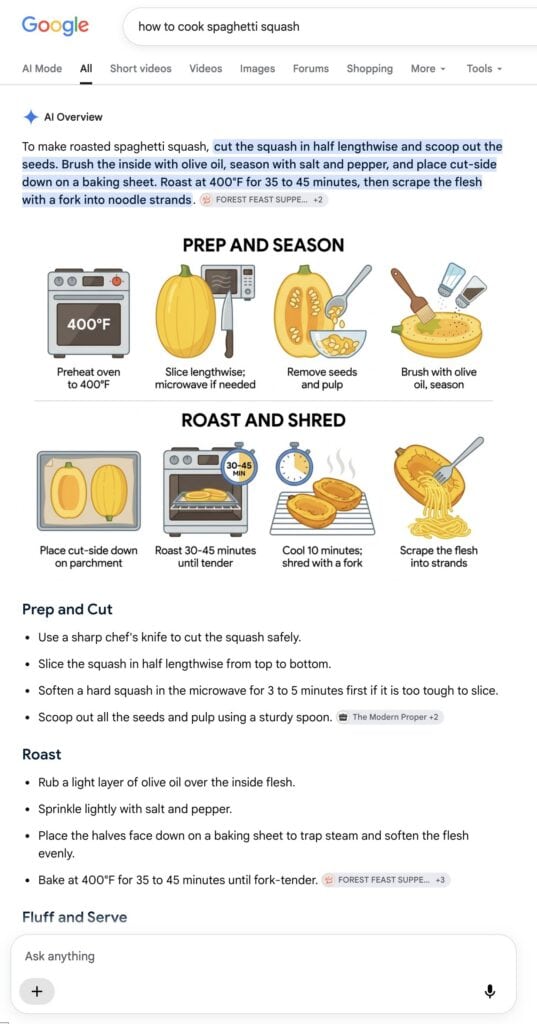
Inspired Taste publicly objected to the test, pointing to the groceries, testing, photography, filming, and reader support that publishers invest in producing recipe content. Robby Stein, Google’s vice president of product, responded that it was a small experiment that Google was no longer running. Search Engine Land documented the test and Google’s response.
The specific experiment ended. During the same month, Google continued expanding other generated visual and interactive experiences in Search. Food publishers should treat the episode as a concrete example of how quickly the search result can move from summarizing information to presenting a generated version of the experience around that information.
Original process photography, tested outcomes, troubleshooting notes, video, and specific observations remain valuable because they document work the publisher performed. They also give readers evidence they can evaluate instead of asking them to trust a generic summary.
Google’s Guidance Centers on Non-Commodity Content
Google also published direct guidance for websites that want to appear in AI Overviews and AI Mode. Its generative AI optimization guide says these features remain rooted in Google’s core ranking and quality systems.
Google says publishers do not need special AI schema, an llms.txt file for Google Search, tiny content chunks, AI-specific writing, or pages targeting every possible fan-out query. Structured data remains useful for established Search features, but Google does not require special Schema.org markup for generative AI results.
The content guidance is more specific. Google recommends content with a unique point of view, firsthand experience, original value, clear organization, and relevant high-quality images and video. It tells publishers to avoid recycling information that already exists online or that a generative AI model can easily produce. Google describes this distinction as commodity versus non-commodity content.
For a recipe publisher, that can include tests that changed the method, substitutions tried, texture and timing observations, process photography, storage results, and mistakes a reader should avoid. For a travel publisher, it can include firsthand logistics, current conditions, neighborhood-level tradeoffs, original images, and decisions informed by being there. These details make the article more useful to a person and give Google source material grounded in experience.
Search Console Added AI Reporting and Publisher Controls
Google completed the global rollout of its Search Generative AI performance reports on August 31. The dedicated Search Console reports show:
- Impressions in generative AI features
- Pages that appeared
- Countries
- Devices for Search results
- Dates with hourly, daily, weekly, and monthly views
The reports do not include clicks. They also do not provide the query, click-through rate, or average-position reporting available in the standard Search performance report. Publishers can now see which pages receive AI visibility and how impressions change over time, but the report still cannot show the traffic or revenue produced by those appearances. Google’s Search Central announcement explains the available dimensions.
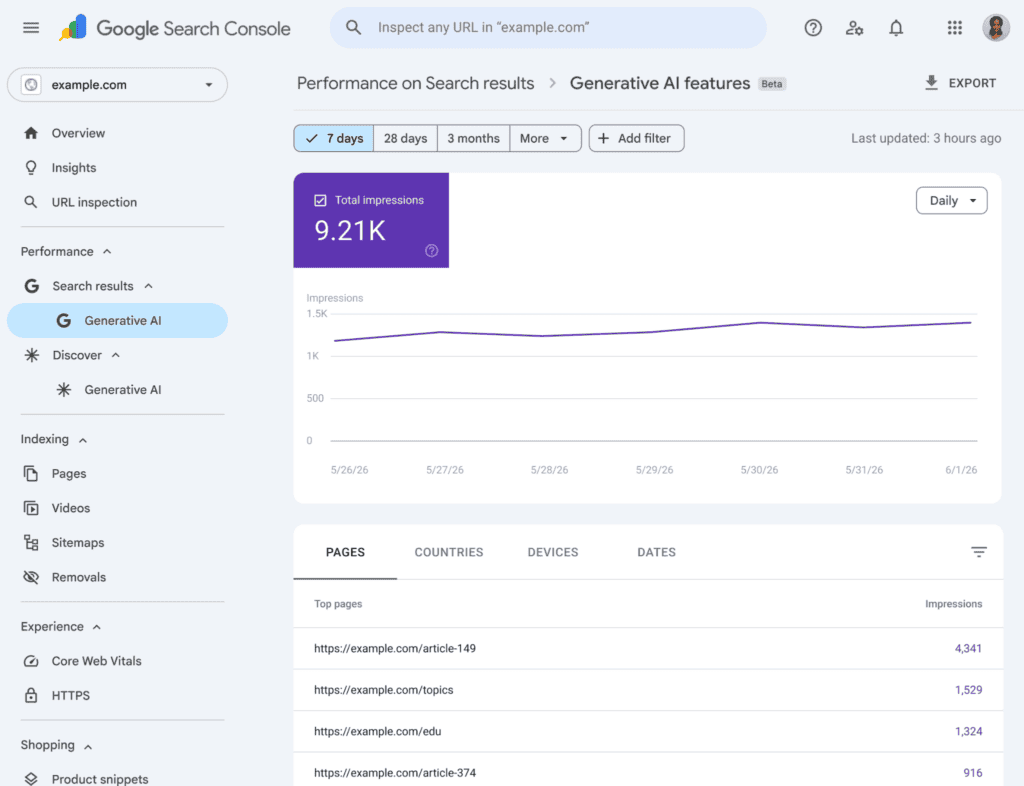
One reporting issue to account for when reviewing August. A logging error caused Generative AI performance report impressions to be undercounted from August 13 through August 17. Google restored the missing data on August 21 and says the report now shows complete metrics for that period. The Search Console data-anomalies page records the affected dates and resolution.
Google also rolled out its Search generative AI control to all websites worldwide on August 31. Website owners can use the Search Console setting to exclude their links and content from AI Overviews, AI Mode, and generative AI features in Discover. An opted-out site will not receive traffic or impressions from those features. Google says the setting is not used as a ranking signal for results outside its generative AI Search features. Google’s announcement explains the tradeoff.
The reporting and control arrived together, but the current report gives publishers only part of the information needed to evaluate that decision. An opt-out removes eligibility for generative AI visibility and traffic while the report still lacks click data. Any decision should account for a site’s audience, business model, observed AI visibility, and tolerance for how its content is used.
Listicles Still Rank When the Query Calls for a List
Kevin Indig analyzed 60,000 U.S. English desktop queries across 15 verticals using SE Ranking data. The dataset contained 5.32 million organic-result rows collected during a 47-hour window in August 2026.
At least one confirmed listicle appeared in the top 10 for 55.1% of the queries and in the top three for 32.3%. Query intent produced the largest difference. Listicles appeared in the top three for 54.5% of explicit-list queries, including searches for ideas, examples, options, or the best items. The rate was 10.2% for implicit category or comparison queries.
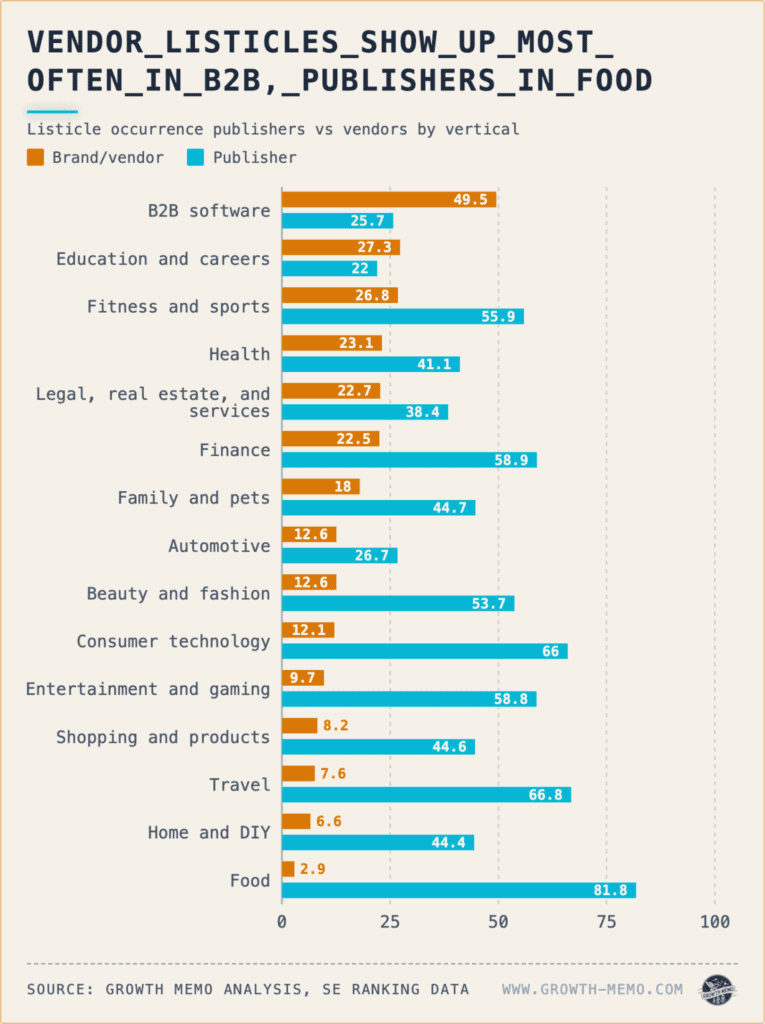
The format remains competitive when it matches what the searcher requested. The surrounding search page makes the click opportunity more complicated. Among results pages with a top-10 listicle, 92% also contained Reddit or YouTube somewhere on the page, and both platforms appeared together on 53%.
The competition also changes by vertical. Reddit’s advantage over YouTube was largest in travel, at 40.6 percentage points. YouTube’s advantage was largest in food, at 40.8 percentage points, and YouTube appeared in the top 10 for 78.1% of the food queries studied.
The full Search Engine Land analysis does not show a universal listicle penalty. It shows that format-to-intent fit remains important while Reddit, YouTube, AI Overviews, images, and other search features divide attention across the page.
Preferred Sources Gives Readers a Direct Say
Google introduced an embeddable Preferred Sources button that publishers can place on their websites. When a reader selects a publication, that source becomes more likely to appear in the reader’s Top Stories and can receive a “preferred” badge in AI Overviews and AI Mode.
The button returns the reader to the publisher’s page after the selection is complete. Google reported that users had selected more than 600,000 unique sources as of its August announcement. The Preferred Sources documentation says the feature is available globally for Top Stories and can appear wherever AI Mode and AI Overviews are available.
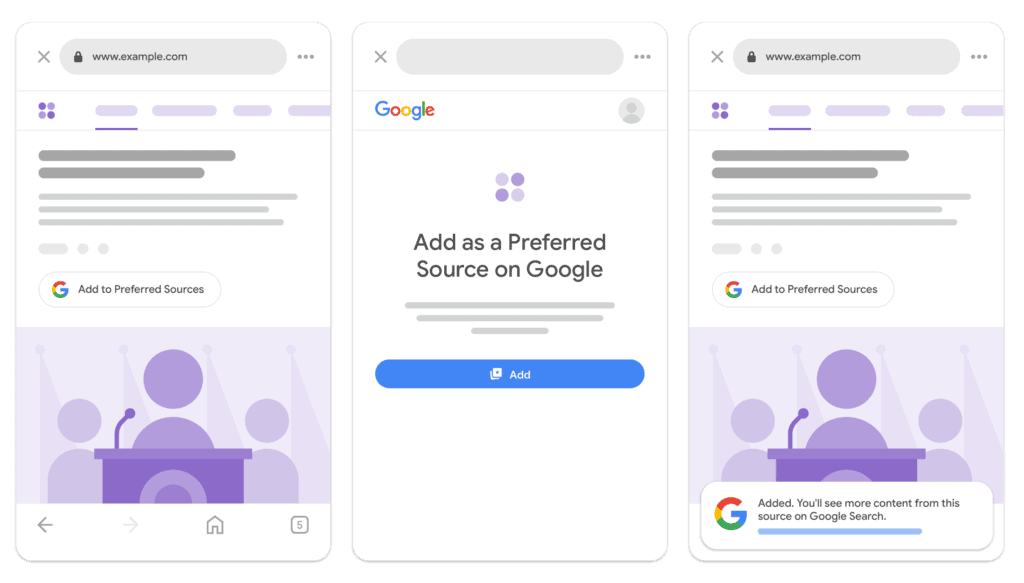
Google also announced natural-language controls for Discover. Users can tell Google which topics or links they want to see more or less often, and Google says the feed will remember those requests. This was a personalization announcement, not a confirmed change to the Discover ranking system. Search Engine Journal covered both features.
Publishers with repeat readers now have a direct Google feature they can promote. Adding the Preferred Sources button gives an engaged reader a simple way to register that preference without leaving the publisher’s page permanently.
Google Can Generate Interactive Tools Inside Search
Google also began introducing Generative UI into AI Overviews in August. The feature was already available worldwide in English in AI Mode. It creates a visual layout for a query and can include an interactive tool or simulation generated for that request.
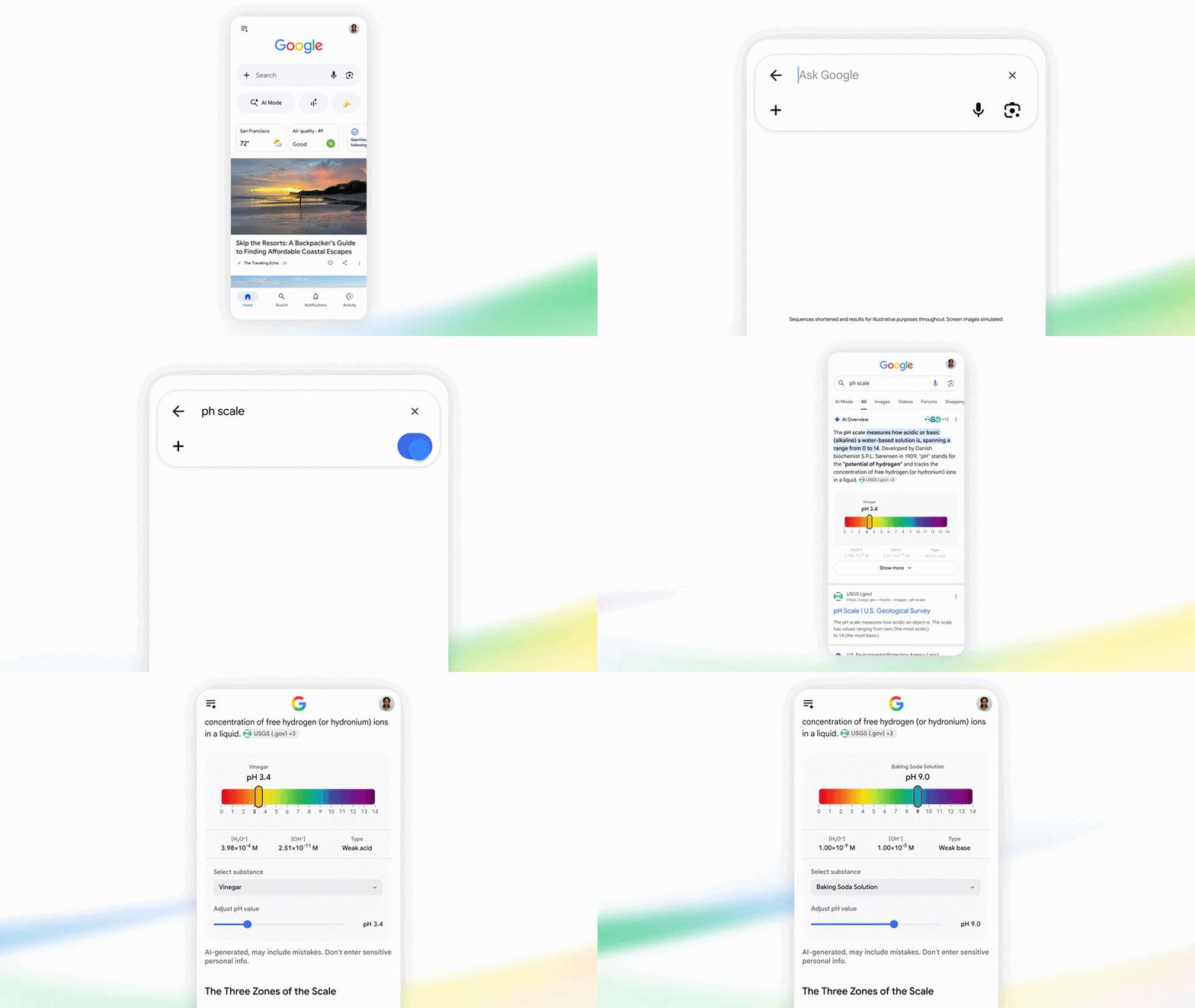
Google has demonstrated educational visualizations, practice quizzes, learning simulations, and a mortgage calculator in AI Mode. These experiences go beyond summarizing the text on a webpage. They can reproduce some of the function that previously gave a searcher a reason to visit a calculator, converter, or other utility page.
Search Engine Journal reviewed Google’s underlying research. Participants preferred a generated interface over Google’s top search result in 90% of head-to-head comparisons on the study’s main prompt set. That figure needs the study’s context.
The main prompts came from a chatbot-evaluation environment and were not representative of all Google searches. Participants saw pre-cached results, so generation time was removed from the comparison. The human-built comparison sites were commissioned for $100 to $130 each and produced in roughly three to five hours. In a second prompt set focused more closely on information-seeking tasks, the generated interface beat the top search result 73.5% of the time.
The study provides evidence that generated interfaces can compete with formula-based utility pages. It does not establish that users prefer generated interfaces to mature websites across the web. Pages built around public calculations and generic inputs face more direct overlap than tools supported by proprietary data, authenticated workflows, expert judgment, or functionality that extends beyond a single generated page.
News Publisher Traffic Data Requires Careful Reading
Several numbers about AI and publisher traffic circulated in August. The most useful study also shows why a single headline number can be misleading.
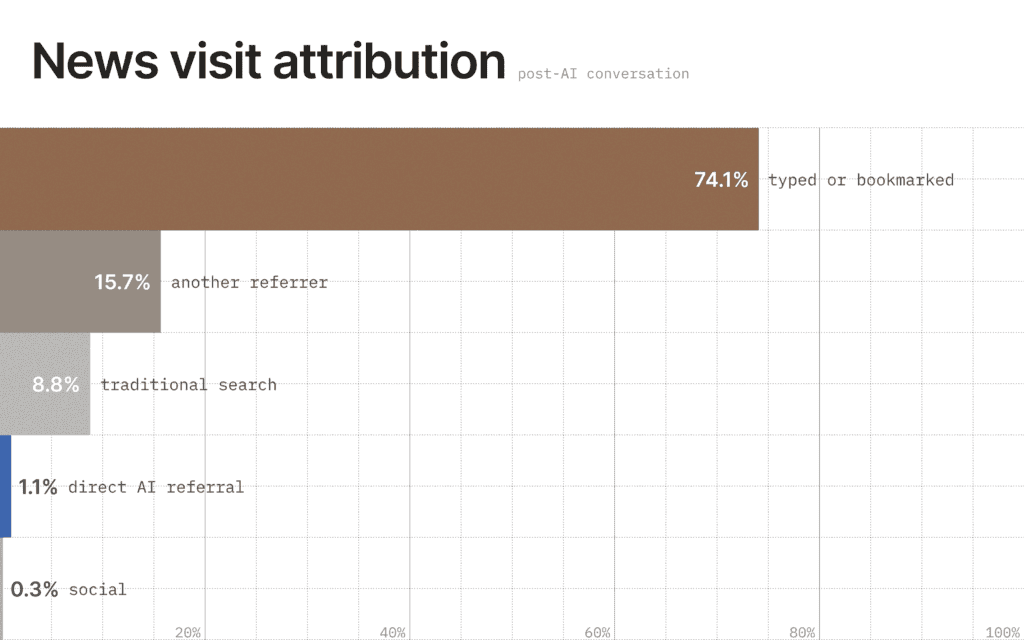
Scrunch analyzed millions of search events, conversational AI sessions, and publisher visits from February through June 2026 using a privacy-safe opt-in panel. Every result in the study concerns news searches and news publishers. The findings should not be applied directly to food, travel, lifestyle, or do-it-yourself sites.
News searches with an AI Overview produced a publisher click about 20% of the time, compared with roughly 30% for searches without one. That appears to be a 10-percentage-point difference. When Scrunch compared the same query observed with and without an AI Overview, the difference narrowed to about two percentage points, which the researchers said was too small to distinguish from zero in their analysis.
The study also found that only 1.1% of news-site visits observed after an AI conversation carried a direct AI referral. Scrunch explicitly warns against interpreting that as the share of visits caused by AI. Referral reporting captures the last click. It cannot show whether an AI answer led someone to search for a publication later or navigate to it directly.
The complete Scrunch analysis gives publishers a useful framework for reading AI traffic data. AI Overviews and conversational assistants occupy different parts of the journey, and aggregate comparisons can reflect the kinds of queries Google selects for an AI Overview as much as the effect of the overview itself.
Publishers still need to examine their own query mix. This study does not provide a universal traffic-loss percentage for AI Overviews.
How Publishers Should Read Their August Performance
August created several overlapping reasons for a publisher’s numbers to move. A clean diagnosis should separate them.
First, compare URL-level and query-level rankings before August 18 with results after August 21. A loss in position during that window deserves a spam-update and content-quality review. A traffic decline with stable rankings points toward a different cause.
Second, inspect the complete results page for the queries that lost clicks. Record whether AI Overviews expanded, whether Reddit or YouTube moved into prominent positions, and whether image, video, or other search features changed the amount of attention available to organic listings.
Third, account for the Search Console logging error from August 13 through August 17. Google restored the missing data, but reports or exports created before the restoration may still contain the incomplete snapshot.
Fourth, review pages that depend on generic information, public calculations, or a familiar format without adding tested experience or original evidence. Keep the format when it fits the query, but give the page a reason to exist beyond repeating the same answer available everywhere else.
Finally, make audience preference easier to express. Email subscribers, repeat readers, brand searches, and direct visits already show that people want a particular publisher. Google’s Preferred Sources button now gives those readers another way to carry that preference into Search.
Search remains an important acquisition channel, but ranking position alone no longer describes the full opportunity. The AI answer above a result, the formats surrounding it, the reporting behind it, and the reader’s preference for a source all influence whether visibility becomes a visit.
Google can reproduce generic information more easily than original experience, tested results, proprietary data, and a trusted relationship with an audience. Those are the assets publishers should keep strengthening as the search experience changes around them.
Arsen R
Founder and Managing PartnerFounder @ TopHatRank, Digital Marketer, SEO, International Speaker, SEO Coach
Read more about Arsen