Melissa Rice (00:00:01):
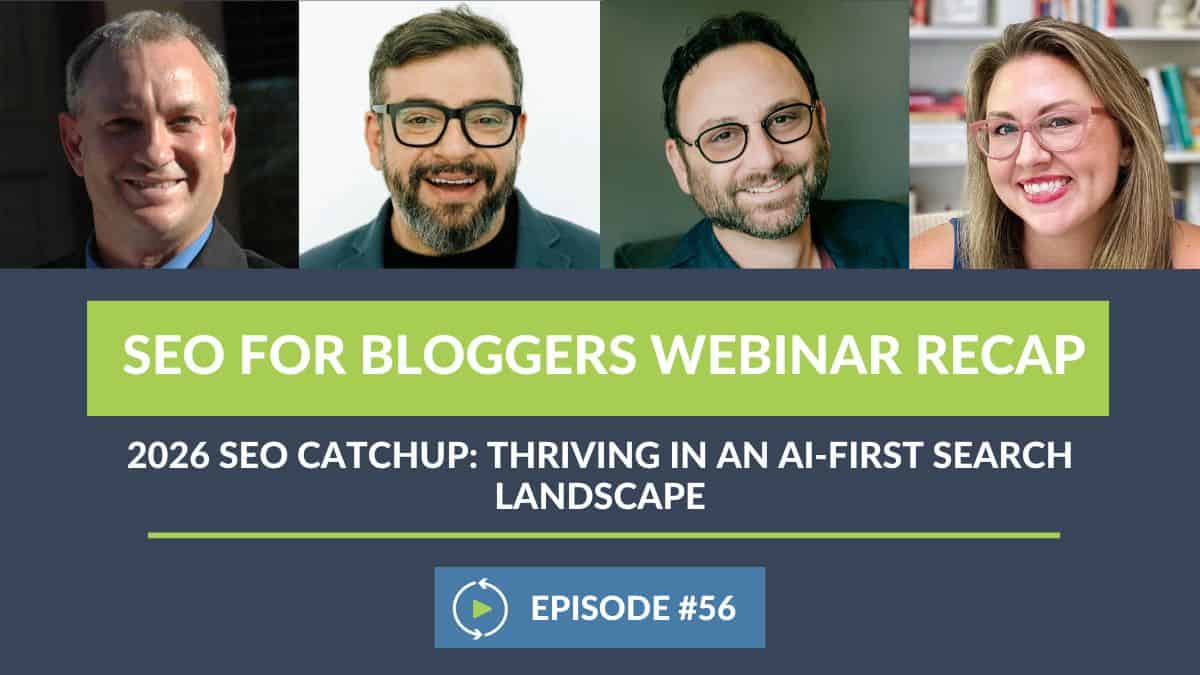
All right guys. We’re closing out the year with episode 53 of SEO for Bloggers. And we can’t think of a better way to wrap things up than by bringing together our full panel of SEO alums for one last timely conversation before we head into the new year. In this final episode of the year, we’re going to be reflecting on the biggest shifts we’ve seen across search in Q4. From Google Core updates and AI overviews to changing SERP layouts, content strategies and traffic patterns. And more importantly, what all of this means for bloggers heading into 2026.
(00:00:38):
Joining us as always is Arsen Rabinovich of TopHatRank, Casey Markee of Media Wyse, Andrew Wilder of NerdPress, and I’m your host, Melissa Rice. A reminder, as always, that we’ll be having our Q&A at the end, so please feel free to drop any and all questions in the chat. You can add the letter Q followed by your question and it will add to the queue for us on our end. And if you see a question that you’d like to answer, please give it a thumbs up to boost it.
(00:01:04):
All right, let’s start unpacking. Casey, first question to you. Is SEO still worth investing in going into 2026 or should bloggers be shifting focus to other traffic sources like social, email, or video?
Casey Markee (00:01:20):
Well, that is a great question. Thank you, Melissa, for asking it. I think we’re going to … let’s try to have a lot of value to start with here. So yes, SEO is absolutely worth investing in, especially for 2026. But as we tend to recommend in every one of these, it shouldn’t be your only strategy. What hasn’t changed is the value of SEO. It’s the role of SEO that’s changed, and especially in the modern publisher business section that we’re all operating in.
(00:01:47):
SEO is no longer a traffic at all costs equation. It’s all about visibility, credibility, eligibility. SEO is going to continue to be very critical in 2026, specifically in three ways. Number one, SEO is necessary to tell Google and AI systems who and what we are, especially with our content. And number two, it establishes topical authority and trust, which is exceptionally needed, especially for AI overviews and everything else.
(00:02:15):
And number three, it determines … Again, to kind of build upon the AI overviews, it determines whether your content is eligible to be used in AI overviews, AI mode answers, voice results, LM training and retrieval systems, all of that. The bottom line is if your site isn’t technically sound, well-structured, authoritative, AI systems simply won’t pick you up even if your recipes are amazing. And we’re already seeing more and more of that as we accelerate through 2025.
(00:02:44):
Now, as for social video and email, those are incredibly important, but you have to look at those as multipliers, not replacements. So we always want to make sure that we’re looking at those as channels that will support and enhance our SEO efforts. Think of SEO as kind of the foundation that’s going to fuel discovery and feeds all these other channels. So I think the best thing to understand, as kind of closing this out is that the real risk for anyone on the call, remember every time we say that we should drink, Andrew, is that the real risk isn’t investing in SEO, it’s investing in outdated SEO.
(00:03:25):
And that’s why we have these webinars, that’s why we continue to do audits. That’s what we want to do. Bloggers need to focus on clarity, structure, expertise while building direct audience channels. And the ones that do that are the ones that are going to win in 2026, so there you go.
Arsen Rabinovich (00:03:43):
I posted a link in there real quick. This just came out today. This is just like how SEO and AI mode are working and how the important SEO is as a signal towards everything that’s happening with AI right now.
Melissa Rice (00:04:03):
Awesome. So Andrew, with AI overviews taking up more SERP, real estate, what is the best way to get content discovered now that AI is a dominant search experience?
Andrew Wilder (00:04:12):
Well, I think we could probably do a whole series of episodes on this, because that’s like the big question. So I’m going to go back to what Casey was just saying and build on that. And what Arsen has said previously where we’ve talked about being omnipresent, that’s really the key, right? Because you’ve got to be everywhere, not only to be everywhere, but because the AI tools are pulling in from all of those sources. And we’ve already talked about that a bunch, but something interesting this week I learned.
(00:04:40):
I was working with Trey from Raptive, he’s their AI expert. We were doing some experiments and we were blocking a site and seeing what ChatGPT would say about it and we put it into thinking mode and then, you can click and see where it went to get its answers. It shows you all the sources it used and it hit Facebook, it hit Instagram, like it hit all these other social media places to try to get information to answer the question about the site we asked, even though it couldn’t access the site.
(00:05:05):
And then, it compiled all of that and was like, “I can’t get you the information you need here, but I’ve got all of these suggestions.” And it compiled a pretty solid answer. It even went to somebody else’s blog post that had written about the blog posts we were asking about. So the tentacles are now kind of everywhere. So I think that’s why you have to be omnipresent. And then, it’s everything that we’ve been saying is like, be clear and direct, like Casey’s talked about the clarity, right?
(00:05:32):
And I think we’re going to talk about schema a little bit later. And so really, it’s just keeping at it and making sure your site is really clean and well organized and you’re everywhere all at once, which of course is easier said than done, but good luck.
Arsen Rabinovich (00:05:49):
We had a coaching call earlier today and I asked the Thinking Mode to retrieve information from website, gave it a URL and it couldn’t grab that page, but it did its own research and was able to find other sources for that information from that website, which I thought was really interesting that it didn’t make anything up, right? And it verified, I couldn’t … It said, I couldn’t fetch that page, but I found this information elsewhere and I think that thinking mode is so advanced right now.
Melissa Rice (00:06:24):
Okay. So Casey, and maybe Arsen, if you want to chime in, what on page signals being structure formatting EAT, schema, originality, actually increase the chances of being cited or surfaced in AI overviews rather than replaced by them?
Casey Markee (00:06:38):
That’s a good question. So the thing to understand immediately is that AI overviews don’t replace content at random. They replace content that’s unclear, redundant, or untrustworthy. That’s straight from the guidelines at Google. So the on page signals that win in AI are the ones that make your content as easy to understand, verify and reuse as possible. What’s the biggest on-page factor for that? It’s structure. It’s how we present our content to be crawled and algorithmically scored.
(00:07:06):
And so pages with layer headings, short sections, direct answers, far more likely to be cited because an AI can quote them easily. Clarity now beats link that basically every turn, you’re seeing the end or complete ratification of long fluffy intros or content that isn’t easy for AI to summarize and digest. They just skip it. And we’ve seen this, especially in audits over the last years.
(00:07:34):
That means for bloggers, and I know we just had a question from Christie about what’s the optimal approach for recipe posts, it could be all of the following. We want clear headings. We want it too long, don’t ask summary or some kind of an AI overview at the top. We want a table of contents to make it easier to jump to different sections. We want user lists and tables. We want Q&A sections. What we don’t want is needless scrolling.
(00:07:59):
We want to make it as easy as possible for a bot or a human, both, to easily digest and understand the partitions and the sections of your post. Now, EAT also matters here. It has to be real. That’s the thing, is that we get all this thing about, “Oh my gosh, I don’t have any real experience on this. How should I be writing this?” Well, a lot of people think that the experience, expertise, authoritative and trustworthiness is incredibly difficult.
(00:08:27):
It really is not. It’s all about firsthand experience. It’s including testing notes. It’s including mistakes you’ve made on a recipe. It’s okay to say, “Hey, I made this 20 times and I made this mistake three times and I’m just saying that so that you know that you don’t do that.” AI can’t replicate that. We also want to make sure that we have clear decision making signals because that’s going to separate your content from any sort of mass-produced content through AI methods.
(00:08:54):
So anything that we can do to make our content unique and stand out, we want to do. And as Andrew mentioned, we are going to get into schema multiple times today, and this is the first opportunity for that. Schema helps AI understand what your content is, but it won’t rescue weak pages. I can put webpage schema, for example, to help entity disambiguation on a post. And if the post is just not very good, it’s in an eggnog recipe that has multiple missteps, no process shots, no real validation on ingredients, all of that.
(00:09:28):
It won’t rank or help that page semantically be better than other pages that have better content. So our goal, of course, is to make sure that if your content looks interchangeable, AI will replace it. And so our goal is to make it as clear, as high quality and unique as possible. So I know there’s shirts … Maybe I’ll have shirts ready for the Tastemaker Conference in LA next month, but I’ve been saying for most of the last 15 years, we want to optimize for toddlers and drunk adults.
(00:09:58):
But now that has evolved into toddlers, drunk adults and LLMs. And it’s very similar in everything that we’ve talked about. We want to make it as easy as possible for Google to crawl and algorithmically understand our content and it’s the same with LLMs.
Arsen Rabinovich (00:10:13):
I’ll jump in here. So I agree with Casey 100%. And you’ve heard me scream that from the top of my lungs since last year, beginning of last year, unique perspective. And I just posted a link in here, what creators should focus. This is an article that just came out, but basically just to summarize it, is that Google has seen the basic information from everyone in many different words. Right now, they’re looking for firsthand experience.
(00:10:39):
Right now, they’re looking for unique perspective. And like I said, we’ve talked about this on many occasions, and unique perspective comes in many forms. It can be talking about your experience with the topic, your struggles with the topic, anything unique that you know. For food bloggers, it’s sensory cues. It’s everything that goes beyond just the basic aspect of that content. And the more of that you do, the more of that unique perspective you bring to the table, and this is why we’re seeing a lot of these sites.
(00:11:11):
We’re like, how are these sites surfacing here? They’re breaking every single form of traditional structure of a post that we’re used to. Well, they’re surfacing there because it’s something that’s unique. They have the basic minimal coverage to qualify as relevant, and then, the rest is unique perspective.
Casey Markee (00:11:34):
And the way to classify that, that’s called the answer layer. And as long as we’re optimizing for that answer layer, you are going to get a benefit, but to optimize for the answer layer, you have to have an answer. That’s why we’re seeing more of these summaries. And too long, don’t ask summaries at the top of recipes, this is why this recipe works. That is not going away. It shouldn’t because we are seeing incredible increases both in percentages of traffic that we’re getting both from AI overviews and regular organic and also in increases in RPMs.
(00:12:02):
If we can get people to invest at the top of the post, they tend to be stickier and then, they’ll journey down the page longer.
Arsen Rabinovich (00:12:10):
We talked about this on the table, just recently last week talked about some Tastemaker thing, right?
Casey Markee (00:12:13):
Mm-hmm.
Arsen Rabinovich (00:12:13):
But the AIO most of the time is going to try to not give you the full answer to your query. It’s going to give you … It’s the bridge. It’s the gap between the impulsive clicks at the 10 blue links and actually familiarizing you with a topic and potentially giving you what you are looking for so you can make a smarter, more educated decision on where you want to click. So AIO is bridging that gap. It’s not trying to give you the full answer so you just get it there unless it’s something simple like conversion units and stuff like that.
(00:12:41):
But we had featured snippets for that, right? But if you search for ingredients for a specific thing, it’s going to give you, here are the basic ingredients, here are ingredients if you want to go gluten-free, and it’s always referencing where to go. So the more of that unique perspectives, the more of that uniqueness that you bring where the AIO is like, “Hey, I need to surface this because the basics is already covered.” You’re going to start winning.
Melissa Rice (00:13:05):
Did you see Tammy’s comment in the chat? Do infographics add to having a unique experience or perspective?
Casey Markee (00:13:13):
Yeah, absolutely. We’ve seen a lot of success with bloggers just adding simple tables that they have put together in ChatGPT talking about, okay, here’s the difference between a high altitude versus at sea level approach to making this baking dish because they found that there was a large … They looked at their data and realized that there was an audience need for that and that meets it. Anything that you can do, that you feel that adds value based upon your own data, and you can also troubleshoot this in ChatGPT, have a discussion.
(00:13:43):
I’m trying to put together this recipe and I’m looking and I’m … What do you think, what would help me set this recipe apart from others around there? You can use a compare and contrast. They tend to have to be a little bit more detailed with your prompt because what we don’t want to do is any rephrasing. It’s a waste of time. But if you do that, you’re going to be good.
Andrew Wilder (00:14:01):
But I think also like an infographic that’s just kind of a standard cooking thing, like a recipe conversion table or something, that’s not unique, right?
Casey Markee (00:14:12):
I don’t know. I can’t. I haven’t seen the infographics, so I’m just going to assume that she’s going to use a quality infographic.
Andrew Wilder (00:14:16):
Right. I think an infographic is really simple. It’s a really cool opportunity to have a unique perspective and something that’s really brand aligned in your voice. Years ago, I did infographics on my food blog and they were flow charts. And I mean, I spent hours building these things and they had fun squiggly arrows and they had a lot of character and tone of voice in them and they were uniquely mine. Nobody else would’ve made them like that.
(00:14:39):
And so they weren’t just any other infographic. And so an infographic is just content in a image form or a PDF form. So as long as it has a unique perspective and it’s compelling for readers, I’m going to keep hammering that one, it’s going to be compelling for AI too.
Arsen Rabinovich (00:14:57):
Sorry, Google is just excluding these pages from Index now. We have clients … On the enterprise side, we have clients with millions of pages, and we’re constantly seeing pages drop out of index. And we’re looking at like, the reason Google’s dropping is because there’s no value in this page. Google already has this information. There’s really no need for Google to have another page covering the same thing over and over and over again.
(00:15:19):
So Google just drops it out of its index, it was like, “I already have this.” And it’s an extreme case with a larger website, but this is how the thing is working now.
Melissa Rice (00:15:32):
Okay. Moving on. Arsen, quick question. How should bloggers rethink keyword research and opportunity analysis today compared to even a year ago, given the shrinking organic results?
Arsen Rabinovich (00:15:47):
There’s a few ways of approaching this. You kind of want to really take a step back from just the traditional approach of, I want to optimize for potato soup. I want to optimize for potato soup. So you have your basic keywords, potato soup recipe, how to make potato soup, all of that, right? But then you also kind of want to take a step back and look at it from a path, right? Somebody who is making potato soup, what else do they need to know?
(00:16:21):
What is important for them? Who is going to be, what’s the audience that’s potentially searching for potato soup? Who’s what the demographic is? And once you start looking at it, once you take a step back and look at it from a perspective of what else does this user need to know? If we’re talking about braised chicken, maybe talk about braising techniques, maybe talk about proper brazing cookware, right? Like Casey said, stuff that needs to be reheated at different elevations.
(00:16:58):
So once you step back and start looking at your content from that perspective, instead of just like, “Hey, am I addressing just the primary intent?” Not the search intent, the intent of the user coming here, what are they looking for? And am I able to effectively predict what are the next steps once the users identified or the readers found what they’re looking for? And if I’m able to do that on the page, I’m able to create much better topical coverage and topical depth as it relates to the user’s needs.
(00:17:27):
And with that comes that ability to start ranking across multiple queries, especially when it comes to AIOs where they use these fan out techniques to search for sources around this topic that are not necessarily ranking for that particular keyword.
Melissa Rice (00:17:49):
Okay. Casey, given recent Google Core updates, including December, what general traffic trends are you seeing and are rankings ever going to stabilize?
Casey Markee (00:18:02):
I’ll be honest with you, I haven’t seen as much volatility as a lot of people would say. And I would say also that I would not worry too much about rankings these days. That’s not really something that is going to provide you much value since Google is basically 99% personalized search now. I mean, that’s the thing is I know people really want to focus on, “Hey, I’ve got this ranking and it seems to have slipped,” but it hasn’t slipped for the person in Chicago.
(00:18:23):
You’re just seeing that because you’re in mobile Alabama. And that’s something that a lot of bloggers struggle to understand is if you buy a ranking piece of software, it’s not really reliable. Even the average rankings that we see in Google Search Console very wildly. My advice to bloggers is to really focus less on those factors and more on bottom line metrics like, is my traffic growing?
(00:18:46):
Am I increasing the visibility of my recipes as a whole? If you have access to something like an SEMrush or an Ahrefs, they now track visibility there as well, which is something that is absolutely going to become more and more important. You have the ability now to track citational visibility like, “Hey, it looks like I’m in 143 AI overviews now.” And then, as I go in two months later, my gosh, I’ve moved up to 400 AI overviews.
(00:19:17):
That’s clearly a good trend and we’d want to continue to do what you’re doing, but it’s not necessarily something I would lose a lot of sleepover.
Melissa Rice (00:19:29):
Okay. Andrew, for those who are the bloggers that are 20% in traffic or down, rather 20% in traffic due to AI and algorithm changes, what’s the quickest and smartest way to regroup without them burning out essentially?
Andrew Wilder (00:19:42):
I think we all deal with burnout from time to time. It gets harder. Working harder and harder is going to be what leads you to burnout. And so, I think the first thing to do is take good care of yourself and find something that you’re excited about and passionate about and try to rekindle the spark that got you into this in the first place. Come to Tastemaker. If you’re not already coming, grab a ticket, come, meet with people, that … At least for me, being an extrovert, that gets me energized and helps with my burnout.
(00:20:14):
For me also, like at NerdPress, we’re struggling with some things too because this crazy economy and I’m now playing with new tools, building apps for internal use to help us become more efficient. I’m having a blast, building new apps with Replit, talking to an AI.
Arsen Rabinovich (00:20:26):
You’ve finally joined the dark side.
Andrew Wilder (00:20:31):
So I’m up at 3:00 AM being like, “Oh, what else can I vibe code?” And do [inaudible 00:20:36] about it. And that has me personally, gotten me a spark. I know we say be omnipresent, but if you hear us say that and you’re like, “Oh my God,” and you’re overwhelmed with dread, then don’t just try to power through that. Find a piece of that that you’re excited about and pursue that for a little while. And so, I think that’s the best way to do it and try to enjoy the holidays and some quiet time as well and Xanax is another option, or Ativan. Just saying.
Melissa Rice (00:21:06):
Did you prescribe these Pharmaceuticals?
Casey Markee (00:21:10):
Yeah. It was unsolicited medical advice.
Andrew Wilder (00:21:13):
Not qualified.
Casey Markee (00:21:14):
Not qualified.
Melissa Rice (00:21:19):
Okay. Arsen, is updating old content still the highest ROI SEO strategy, or is there still room for new content to drive real growth in 2026?
Arsen Rabinovich (00:21:30):
Yeah, absolutely. New content, you should be doing both. You should be updating old content and creating new content. And to kind of go back to what Andrew was talking about, organize around … And again, we’ve said this before, we’ve talked about this. Organize around stuff where you are able to make meaningful changes and see results, even if they’re short term or low effort results. A little bit of work, of looking into content that has potentially, or was performing in the last 12 months.
(00:22:10):
And very easy stuff you can see inside of search console. Content that was performing in the last 12 months and has since dropped off and is not ranking. You can take a look and you’d be like, “Oh, listen, I’m still on page one. I just dropped out of my top three positions. Maybe this is a piece of content that you should get a little bit of attention from me.” And probably doesn’t require a lot of work too because it’s not like you need to do a rewrite, you’re still relevant.
(00:22:35):
It’s just Google saying somebody else is satisfying what the users want to see. And your job is to compare and see what they are doing that you are not. And you can make these small incremental changes. You can start doing this and seeing improvements. You don’t have to rewrite the entire post. You don’t have to wait … I might catch some heat for this. You don’t have to wait to publish the post just because you don’t have your process photography ready.
(00:22:55):
Publish the post. Let it start getting picked up. Add your photography later. Do the things that make you happy, but still are kind of helping you with that. Yes, optimizing content, revisiting content that’s already been published. You already spend the time. You already worked on it. You already have the assets. Probably has good presence. Review the internal links. Look at the anchor text. Look at the context signals that you’re sending to that post.
(00:23:21):
Take a look at page one of Google for that primary query. How are people writing their title texts? What is Google’s considering a good Meta description for this post? Make those minor changes and you’re going to see results little by little by little it works.
Casey Markee (00:23:35):
Fill in your recipe schema of fake people.
Melissa Rice (00:23:38):
Yeah.
Casey Markee (00:23:38):
Fill in your recipe schema. Go in under tasty. Go in under WP recipe. Look at your dashboard. Fill in everything that you can, that is a ranking factor. Our goal is to increase all of the visible rich snippets we can in the carousel, which will increase your visibility, which will increase your conversion, which will increase your traffic. So go in, fill in all of your recipe schema, add notes. All of that stuff is algorithmically scored. All of that helps you.
Melissa Rice (00:24:07):
Well, Andrew, that was part of my question to you. Are things like Schema and Core Web Vitals important for AI overviews and other AI search platforms?
Andrew Wilder (00:24:16):
Yes.
Casey Markee (00:24:17):
That’s it. Novant. He doesn’t need to say anything else.
Andrew Wilder (00:24:23):
And I’ll add in terms of schema, it’s not just recipe schema that you need to be doing, right? In US SEO, you want to be filling in all of your profile, same as stuff. So all of your social links. Make sure if you’re set as an organization, which you probably should be, make sure that is configured properly. So there’s more schema than just recipes. And the thing about the schema is the whole point of schema is that it’s telling the machines more about your information, right?
Casey Markee (00:24:49):
Exactly.
Andrew Wilder (00:24:50):
Casey and I had an interesting conversation the other night. Schema may go away in a few years. I mean, I think schema is stupid. I think that they shouldn’t have had to require schema. They should just be able to read a page like a human and understand it. The problem is they weren’t that good. And the schema is really training the AI. So just like we have to … When we have to click on bicycles or crosswalks in a CAPTCHA, what are we doing? We’re training visual AI.
(00:25:16):
They’re using us to do that. They’re using our sites here to train the AI. In a couple of years, you’re going to be able to have a recipe like we used to before we had recipe schema and recipe cards where you just have a bullet point of ingredients and it’s going to understand it, just fine. But for right now, that’s not working. So really a schema just helps the digestibility and understandability to help with AI overviews. And as for Core Web Vitals, they’re, I’d say more important than ever.
(00:25:42):
It’s table stakes right now. And your site needs to load very quickly, be user-friendly, et cetera, et cetera. You all know this already. So that is very important. Anecdotally, we’ve been hearing more reports of a site falls out of the good range for Core Web Vitals and it drops in ranking the same day. And then we fix the Core Web Vitals and it drops. It comes back up the next day. There is a much faster correlation now to the corporate vitals and rankings, particularly in a competitive search.
Melissa Rice (00:26:11):
Okay. Follow-up question for you, Andrew. How can bloggers use AI safely and effectively to work in their favor without harming trust, originality and long-term visibility?
Andrew Wilder (00:26:22):
Use AI safely and effectively without harming trust and originality?
Melissa Rice (00:26:26):
Mm-hmm.
Andrew Wilder (00:26:26):
So there are lots of different ways to use AI. Where I’ve kind of come to now is I really hate the way AI writes things. I don’t like using AI for creative output. I write better than it does. And I think we’ve all kind of seen the AI writing enough now that you can start to see the patterns. And LLMs are predicting words and by definition then it’s statistical prediction. So it’s like kind of giving you the lowest common denominator.
(00:26:53):
And you can do a ton of work to train it to be in your voice, but it’s still never going to be you. It’s never going to have that creative spark of insight. And so, I think the single biggest thing is don’t have it write your blog posts. But you can use it as a tool for helping you write your blog posts. You can do content outlines. You can get a first draft and then you rewrite it a lot. But I think everything that you publish should look at … you should feel like it’s as if you wrote it from scratch.
(00:27:17):
That’s the key. And if it can output it, 5.3 might be able to do it, right? It’s only getting better. But if you cannot distinguish the writing from your writing and the AI, then I think you’re not going to hurt your brand or your voice because it’s going to be your voice if you can’t tell the difference. And the problem is if other people can tell the difference. I think beyond that, content is content. So it just makes sure your content is good no matter what. No pressure, again.
Melissa Rice (00:27:46):
No, pressure. Yeah, exactly. Arsen is concise content outperforming in depth post right now and should bloggers consider trimming content rather than adding more to it?
Arsen Rabinovich (00:27:59):
That’s interesting. So I’ve been watching some of the fluctuations right now and in the past few updates, and I am noticing that … And you got to take this with … There’s a caveat. So it depends on what, it depends. So we got to talk about content length versus topical depth when we’re looking at this. So some queries might not require a deep dive into … And I’ve said this before, like a peanut butter jelly sandwich recipe probably does not need a deep dive into different variations and all of that.
(00:28:39):
While a Borscht recipe might require a little bit more information. And that’s really determined by the user at the end of the day, because Google will rank across a period of time, short form, long form content, all kinds of different content, different document types, videos and stuff like this on page one. And we know that they’re monitoring how users are engaging with those objects on the page.
(00:29:03):
And over time, it learns from that and it’s able to understand, hey, for this particular query or query type or topic, this is the best type of a result based on user feedback. People clicked and they stayed meaningful visitors. So over time, Google is able to understand that, hey, peanut butter jelly sandwich probably does not need 3000 words. So shorter uniform content across the board for easier topics that are not very in depth is definitely winning.
(00:29:37):
I’m definitely noticing that and not only so much more concise, stricter content, it’s the content that prioritizes what the user is looking for closer to the top and addressing the user’s needs. But then again, I’ve clicked, I’ve searched for something, I clicked over, I’m looking at it and it’s not giving me what I need. I need to scroll. I’m probably going to bounce back. So it’s this chicken egg situation?
(00:29:59):
But definitely, we look at page one, the top 10 results and take a look and see what Google is showing there because most likely the top three, four results are there and have been selected to be there because of how users are interacting with that result page.
Melissa Rice (00:30:19):
Excellent. Casey, what is the single highest ROI SEO action bloggers can take in the next 30 days to strengthen site-wide authority and traffic?
Arsen Rabinovich (00:30:31):
One action.
Melissa Rice (00:30:33):
No pressure.
Casey Markee (00:30:34):
One action.
Arsen Rabinovich (00:30:35):
One action.
Casey Markee (00:30:36):
One to rule them all, so to speak. Fantastic. We’ve already answered it. Yeah. That’s included though. No, we’ve already answered. The highest ROI SEO action bloggers can take in the next 30 days is to audit and fix existing content. Period. Not create new posts. If you have the time, great. Take an 80 to 90% approach. For every eight or nine posts I update with best practices with all that you’ve learned over the last several weeks, months, year, you might publish one or two posts.
(00:31:09):
But the best thing you can do is identify. Go into Google Search Console. Identify your top 20 to 50 posts that already have impressions. See if we can improve the clarity, see if we can tighten the structure, see if we can update the answers, remove anything that’s outdated or bloated. Add internal links that reinforce topical authority, make sure that every page clearly answers the one intent to rule them all, that you’re looking to get across.
(00:31:33):
You should also be adding AI summaries. You should be looking at table of contents. You should be looking at writing correct FAQ blocks. If you have an FAQ block on your site and all it says is this will freeze in 30 minutes, that’s a wasted FAQ. Not going to help you. You need to be going and looking at your people also ask questions, collapsible container that’s being returned for your target query. And look at what is in there.
(00:32:00):
Every one of them has the focus keyword for a reason. So if you’re scared or if you’ve been giving some bullshit advice over the last couple of years where you shouldn’t be putting your primary keyword in your FAQs, ignore that. Find out who told you that and punch them in the mouth because that’s hurt you. I can’t tell you how easy it has been to get people into PAAs by having them go in and write complete FAQs.
(00:32:24):
Yes. Can I substitute this in my gingerbread loaf? That is a complete question. You saying, “Can I substitute flour in this recipe,” is not a complete question. So doing little things like that will help you considerably improve your intent and get you featured in those PPAs.
Andrew Wilder (00:32:46):
Can I also say frequently asked questions, you should be putting the actually … questions that are actually asked frequently. Don’t just sit there and go, “What do I think people are going to ask? Do your homework.” If it’s an existing post, pull those from questions you’ve gotten in comments, right? Or like Casey said, the search suggestions people also ask are coming from real things. When we did the frequently asked questions on the nerdpress.net website, I worked with a marketing consultant.
(00:33:13):
And he made us go back through a year of sales inquiries, compile all of the questions that were asked. And we know a lot of them are slightly different. We grouped them together and the questions that are asked on our frequently asked questions page are actually the questions that are asked and the most recent question or the most popular questions are at the top.
(00:33:29):
They’re literally sorted in order from like, “We got this question the most, so let’s put it up front and center.” By doing that, by doing our homework, it actually makes those useful, not just filler. So I think don’t just put it in there because Casey said add FAQ, make sure they’re actually useful and have a unique perspective, are really helpful.
Casey Markee (00:33:46):
Yeah. And I mean, the thing to understand about that is that anything you can do to improve your posts you want to do, but some improvements are better than others. The reason that we want you to focus on the older post is that this Google and AI systems already know these pages exist and trust them. Understand that you’re always going to have more success improving existing content than adding new content. You’re not asking for trust from scratch.
(00:34:12):
You’re just strengthening signals that are already there. That is why I really want to focus people on understanding that if you have limited resource, always focus those resources on updating existing content. And then if you have the time, great. Add one or two new posts here. But when I do an audit and I find that I’ve got a whole … They have 500 posts on their side and here’s a list of 322 that haven’t had one click from Google in the last four months, do you think you should be adding new content to your site?
(00:34:42):
Your site is not a book where you need to keep adding pages. That’s a myth. Your site is a garden. You need to work at pulling those weeds and turning them into flowers where they’ll kill the flowers. And that’s what we’re doing when we’re doing content.
Andrew Wilder (00:34:55):
Casey, that’s the teacher you need. Your site is a garden.
Melissa Rice (00:34:57):
Thanks. Go pull some weeds.
Arsen Rabinovich (00:35:01):
That’s a new one. I like that. That’s the back. Is it my turn? Do I answer also on this one or what’s happening?
Melissa Rice (00:35:06):
Sure. I mean, if feel like it.
Arsen Rabinovich (00:35:06):
Is this the one where all of us say something?
Melissa Rice (00:35:06):
No, the next …
Arsen Rabinovich (00:35:14):
Okay. I’ll wait then. I’ll wait. I’ll wait.
Melissa Rice (00:35:15):
Well, this is a sort of … Everybody can contribute.
Arsen Rabinovich (00:35:19):
Yes. Yes.
Melissa Rice (00:35:20):
But I want to look ahead for a minute. Just picture it with me. Looking ahead to Q1 of 2026 and beyond, what priorities should blogger set to protect against these seasonal slumps and position themselves for future growth? We’ve touched on it a little bit through this episode, but let’s round it out.
Casey Markee (00:35:42):
Well, let me start here. So seasonal slumps happen. The thing to understand about them is that even if you have seasonal slumps, what’s always going to hit you hardest as a sign owner is technical issues. It’s unclear structure. It’s diluted topical focus. You can overcome all of that. If you look at maybe investing in, “Hey, what am I going to say, Arsen?” Professional audit. Get a second pair of eyes to look and make sure that you understand what is going on.
(00:36:18):
The goal of course is … And I say this because an audit helps you identify what’s actually holding your site back. Okay? What content needs to be fixed, what content could possibly need to be removed. Bottom line is where can we strengthen authority across your site? Sometimes we’re so close to our site that we fail to see the big picture. Just like when my wife tells me to clean a room and I’ve totally forgotten there’s four corners to the room and I only cleaned three of them because I didn’t move furniture, I’m going to hear about it.
(00:36:45):
So it’s very similar to a side audit. There are things that only a professional is going to be able to see. And when you see those, you’re going to be shocked at how much better you do, but if you carry a site audit with updating evergreen content and you look at owning or building out and focusing on one owned channel, say email, then you don’t have to worry about panicking about the occasional seasonal dip in traffic.
(00:37:10):
You’re going to be using all of this extra time to compound your growth. And that’s what’s going to separate the bloggers in 2026 from those that are beating the algorithms and building traffic to those that are struggling and wanting to give up the farm, so to speak. So definitely consider that. We provide a lot of free resources, especially in this webinar. I’ve provided a lot of free resources in my search into land articles.
(00:37:34):
You can do a self audit pretty easily if that’s your goal. But understand, get your technical house in order. Make it so that your site is so algorithmically attractive to Google, they would be embarrassed not to rank you. And a lot of bloggers can’t say that.
Melissa Rice (00:37:50):
Well said.
Arsen Rabinovich (00:37:51):
How algorithmically attractive is your website?
Casey Markee (00:37:54):
Bam, bam.
Arsen Rabinovich (00:37:55):
Right.
Melissa Rice (00:37:57):
Anybody else want to chime in on this?
Andrew Wilder (00:38:01):
Go ahead, Arsen.
Arsen Rabinovich (00:38:02):
I was going to just quickly say, look, I think looking from an easy win low effort approach, right? And I’ve said this earlier, definitely take a look at your internal links. I review a lot of sites where the internal links are just causing all kinds of dilution. Some people have posts that have been rewritten, refocused. You might have had a gluten-free chocolate chip cookie recipe that you then decided to make, not gluten-free in just like a normal chocolate chip cookie recipe.
(00:38:31):
But your internal links are still saying gluten-free chocolate chip recipe. You’re sending confusing signals and those are easy fixes. Also, you might have recipes you’re like, “Why is this not ranking?” Well, maybe because you haven’t put in the proper internal links. I’m going to share a YouTube video here. I recorded this about a year ago. It’s how to do an internal link audit using Link Whisper. It’s free. It’s easy to use. Their user section, UX changed a little bit, but you’ll get the point. Take a look at that.
(00:39:04):
This is one of the easy … We rescue so many posts we just improved internal links. You’ve slipped maybe a few positions here and there. Take a look at the internal links.
Melissa Rice (00:39:14):
Thank you.
Andrew Wilder (00:39:15):
All right. So my answer for that isn’t an SEO one. It’s diversify. We’re in a crazy time where things are changing and who knows where we’re going to be a year from now, let alone five years from now. And the one thing that I don’t want to see people doing is going, “How do I get more rankings in Google?” And that’s my optic view because you may never be able to rank well in Google again in six months. Who knows? Google may not exist. Websites may not exist. We don’t know. It’s a crazy time.
Arsen Rabinovich (00:39:45):
Why are you bringing all this nonsense here, right? Why would you even put it out there like that?
Andrew Wilder (00:39:50):
That totally took a wrong turn.
Casey Markee (00:39:55):
Andrew might be on some prescriptions. That’s all I’m saying.
Andrew Wilder (00:40:02):
And maybe the Ativan thing. No, and we’ve been saying for years, diversify, right? Not just your traffic sources, but your revenue streams. Interestingly, I think a lot of people watching here today are food bloggers, but there’s lots of other types of content creators out there. And I don’t know if we have any travel publishers. Give us a shout in the comments. NerdPress has been going to some travel conferences in the last couple of years.
(00:40:23):
And the interesting thing has been that the travel publishers are incredibly diversified. Some people have 13 different revenue streams and they’re on … And some people don’t even have a website. And my answer to them is like, you need to diversify and put more into your website. Food bloggers have the opposite problem, whether it’s like website, website, website, because it’s been so easy to make money with ads on food blogs in particular, and there aren’t enough other revenue streams.
(00:40:44):
So I think my challenge to you in 2026 is find just one new revenue stream because the first one you tried may not work, it may work great. You’re going to have to probably try a few, but there’s a lot of things out there that can make you more money besides ads. And I want to give a shout-out to both Leaky Paywall and Grocers List. They both have a feature that’s very easy to add for a membership site to just turn off ads.
(00:41:08):
So you can go to them, they can set it up for you where it’s like people, you put a little like, get an ad-free experience and for whatever price you set, 40 or 50 bucks a year, some people will opt into that and when they’re logged in then, they don’t see ads and they’re paying you for that. And it was really cool talking to both Ben and Pete about this.
(00:41:25):
They both have built tools to make this easy. They take a cut, like 10 or 15%, but they set it up for you. So it’s like all you have to do is reach out to them and say, “Hey, I want this.” So I know Grocers List is also going to be a Tastemaker. So make sure you talk to Ben about that, at Tastemaker, because it might be real easy for that to be your New Year’s resolution to be like, “I’m going to try this.” But maybe you sell an ebook, right?
(00:41:46):
Maybe you start doing food tours in your city. There’s lots of ways to diversify that aren’t just-
Arsen Rabinovich (00:41:50):
Sell Xanax on webinars.
Andrew Wilder (00:41:52):
Sell Xanax on webinars. I was laying the foundation there.
Melissa Rice (00:41:59):
Again. Conceal your [inaudible 00:42:00].
Casey Markee (00:42:00):
We are not providing medical advice. Disclaimer has been added.
Melissa Rice (00:42:08):
Yes. Okay. Did you have anything else, Andrew? Sorry.
Andrew Wilder (00:42:13):
I was just going to say I’m just overcaffeinated today. That’s all, really.
Melissa Rice (00:42:17):
Love that for you.
Arsen Rabinovich (00:42:18):
For all of us.
Melissa Rice (00:42:21):
For all of us. All right. Well, I think we should add it into a Q&A. We had a couple of questions that were partially answered. So Arsen, I think you had … Somebody asked this during one of your questions, but you didn’t cover the second half, which was, can you go over what the latest recommended structure for recipe post is? Or maybe Casey, you answered that first half, but what about a recipe roundup post?
Arsen Rabinovich (00:42:49):
I mean, a recipe roundup post is just a list item post, right? So it’s a topic. Here are my best Thanksgiving recipes, and you’re going to list them. There’s many ways of doing this. I haven’t seen too much diversity in how these are presented other than the aesthetic and the layout, but these are list item posts, right? They’re collection page posts, right? Schema should be, Casey, collection page or list item, one of those, right?
Casey Markee (00:43:17):
It’s list item. There’s no carousels devoted to this anymore, so to me, it’s a bust. My advice when people are putting these posts together is to really start thinking about how useful they can be. No one wants to wade through 30, 40 or 50 recipes anymore. We’ve seen the heat mapping on it. My advice to anyone who asked me about a recipe roundup post is really structured as a post. Say, “Hey, I’m doing this for this reason. This is my top selection. This is my number one best roundup item.”
(00:43:48):
And then, tell them why at the top and then say, “Oh, by the way, here are the also rans. And if you can split up up into various categories to segment the intent even better,” and then end with a conclusion or something like that. But what people don’t want to see is I’ve got a weak introduction, I’ve got 50 listed item list sections, no conclusion, that’s just not going to do anything for you.
Arsen Rabinovich (00:44:09):
How helpful is that page? And you got to ask this-
Casey Markee (00:44:11):
Yeah. How helpful is the page?
Arsen Rabinovich (00:44:13):
Right, right, right. And one of the things, so what I’m noticing a lot, and we see more Roundup style list item posts in travel than in food. Giving it some kind of a reason, not just like here’s top 10 things to do in Spain, but actually list saying why, right? For recipes, it could be something along the lines of, here are the top 10 holiday cookie recipes based on positive feedback, based on star ratings, based on … give it some kind of a meaning or a reason.
(00:44:53):
Don’t just create, here’s a list, just to create a list. And that goes a long way, especially with AIOs.
Melissa Rice (00:45:00):
Okay, great. I’m going with Carol’s question next. Please talk about the new AI summary buttons bloggers are putting on their sites and the best place to put them.
Casey Markee (00:45:14):
I provided an example here, but I think you could play around with where you want to place those. David Leite of Leiths Culinary, for example, he only puts them in his recipe cards. He’s been checking with that. He loves it. He does a lot of substitutions and additions. You can check his site. That’s leithsculinary.com. We can probably place a link in there. But you’ll find that usually we put them below the featured image as we go into the post.
(00:45:37):
Here’s a nice little AI summary. I’ve provided an example from PlatterTalk that’s very nice. Dan and Dan Zara, I think he’s on the call, actually did a fantastic job with that. I reference it all the time. There’s lots of other options. We are also pushing the Google trusted resource button, which is really cool. And I’ll actually provide a link to David’s site here. David is actually on the call.
(00:46:01):
I’m going to have David actually paste over a link to one of his recent recipes. He has a trusted source button at the top.
Melissa Rice (00:46:08):
Nice.
Casey Markee (00:46:09):
Pretty awesome. And it’s really nice. And anything we can do to seed Google that we should be saved as a highest meets needs result on your own reading list will help us increase our profile for Google Discoverability. And that’s what we want to do. The more people that we can have save us as a trusted source, the better chance you’re going to get viewed in Google Discover, the better chance that Google might provide you some benefit to those users by means of personalized search.
(00:46:40):
It’s a 99% personalized search now. And so, if someone is saving you, if someone is going to click on a button and save you as a trusted source, I think the odds are pretty good that they’re probably going to see more of you and their results going forward. And that’s what we want.
Andrew Wilder (00:46:57):
And there was a question about how to add the buttons and I want to say we got you. We are, as I speak, adding them to Hubbub. We have a beta version already that I was testing this morning. So we’re actually taking the AI buttons kind of one step further and creating action buttons that can be buttons that do any action. And so, AI buttons are going to be one of those buttons that we ship. So you can create them. We’re building them to be very flexible.
(00:47:23):
So you can do a “Summarize this post” if you want, or you can do a “Double this recipe” and you can send it to ChatGPT or you can send it to Perplexity. And we’re going to have the “Add me” as a trusted resource button as well. So we’re beta-ing it now. We’re going to run it past Casey and make sure he signs off on it. And we’re building them as a block that you can add in post individually or just automatically insert them. It’s going to be super flexible and we’re going to ship it.
(00:47:47):
I hope next week, but certainly before Tastemaker. So coming soon and we should make that really easy for you in Hubbub Pro.
Melissa Rice (00:47:54):
Awesome. Hubbub. Pray.
Andrew Wilder (00:47:59):
Yeah.
Melissa Rice (00:48:00):
I know. A lot of love in the comment section.
Andrew Wilder (00:48:02):
Basically told me he’d kill me if we didn’t build them. So I’m like, okay, we’ll do it.
Melissa Rice (00:48:06):
Okay. Nice. Speaking of placement, Andrea had asked, where do you put your FAQs in an FAQ block or in the recipe card? I think you touched on this, Casey. Can you remind us?
Casey Markee (00:48:19):
We’ve provided two examples. We provided a link to David’s recipe and we also provided a living chirple and you’re going to find that both of them have an FAQ section. That’s what I recommend. So you can take a look at that. I wouldn’t want to put them in the recipe card, that’s for sure.
Arsen Rabinovich (00:48:34):
So there’s a few ways of approaching this and we want to look at things from a perspective of … and what Andrew said, is this truly a frequently asked question? So there are some questions that will be surfaced or presented to you that are relevant to a section of your content that you’ve already covered. And it could be like a question about a substitution. And if you have a substitution section in your content, in your article, maybe that would be a good spot to answer that question because that’s where you’re covering that subtopic.
(00:49:17):
So not everything should be going to your FAQs. And I think that’s what the framing of that question was from the … Whoever asked it, I forgot the name, immediately. So you want to approach it. And then some questions might warrant creating an H2 section. It might not need to go into an FAQ blog. So it’s definitely at your discretion and you want to … Casey, should we quickly maybe talk about content chunking and do you think that’s relevant here?
Casey Markee (00:49:48):
No, because content chunking isn’t something we can optimize for.
Arsen Rabinovich (00:49:51):
Okay.
Casey Markee (00:49:51):
That’s something that I think bloggers tend to understand. It’s an AI term, but it really doesn’t help bloggers with regards to content chunking. Content chunking is a term by means by where … it’s just a backend. It’s like Fantail queries. It’s not like we can really optimize for that. We can say we can, but we really can’t. I would say that your goal is to write a complete post. If you’re doing a substitution section and you find that it’s relevant to say, “Oh, by the way, this is a common question I get.”
(00:50:16):
Sure. Go ahead and include it there. I think it’s great. Your goal, of course, is always to look, take your focus keyword, go into Google, see if there’s a people also ask query section. I’ll be honest with you, if you go into Google and you see that there is no PAA or people also ask, probably not even really worth you worrying too much about putting an FAQ box because there’s not really anything there to target.
(00:50:40):
Now, that being said, if you feel that there are appropriate questions, always take a user first approach. If you’re like, “No, I’ve made this a ton of times and I wish I had known this, the first 10 times.” And that is a great option for you to pull out information. In the end, you are the best judge of what tips and questions should go in your post.
Arsen Rabinovich (00:51:02):
And Google is smart enough to figure out what the question is and what the answer is. You don’t necessarily need to explicitly put it in the FAQ or market up.
Melissa Rice (00:51:12):
Right. Okay. Diane had a couple questions. We were talking about schema earlier. Do you have a list of mandatory schema that should be on every site?
Casey Markee (00:51:25):
Most sites have breadcrumb schema built in. Most sites have article schema built in. You’re covering recipe schema by means of your recipe plugin. Things like organizational and knows about, and same as schema is covered by most of your SEO plugins. You’re good. Don’t worry about going out and trying to find these other missing recipe schemas. FAQ, if you want to put FAQ scheme and great, that’s covered by the host FAQ block.
(00:51:49):
But don’t run out thinking that we need to add all this other extra schema because in many cases, you’re probably deploying it incorrectly or it’s not being recognized by Google.
Arsen Rabinovich (00:51:57):
It’s not a ranking factor. You don’t need schema to rank. You can have-
Casey Markee (00:52:01):
Yeah, schema is not a ranking factor. Schema is just helping you optimize for the answer layer. That’s it.
Arsen Rabinovich (00:52:06):
Right, you’re essentially taking … you’re helping Google digest what’s on the page. You’re taking it from implicit to explicit with schema. So this is a recipe, here’s the recipe card, here’s all the details. Instead of Google trying to process and figuring out. But Google will still do that, so you don’t need it. Google is kind of layering that playing field. So you don’t need it to rank organically different maybe for recipe card and AIO and everything else, but organically, you don’t need schema to rank in the top positions.
Melissa Rice (00:52:33):
Okay. And then, her second question, I think maybe you might’ve already addressed this as she had asked, where do I see tracking for citations?
Casey Markee (00:52:41):
Well, the two big places right now, I mean, I think you can actually go in and see questions. We can actually still sort in Google search consultancy questions, which can provide insight on citations. But if you’re looking to actually track where you are for AI overview visibility and how you’ve grown with regards to ChatGPT and Perplexity specifically, you have to use a third party tool. SEMrush now, for example, has just rolled out that as a feature.
(00:53:09):
It’s in all of their sections. It’s okay. Ahrefs just rolled out a fantastic new standalone tool where you can just buy individual credits to use it. So that’s something you might want to consider. But you’re going to find that there’s going to be plenty of these tools released by the bucket in the next 90 days specifically. So hold out, see what you see.
Arsen Rabinovich (00:53:33):
There’s a tool that you can use. It’s called Thru. I’ll drop a link. Give me a second here. So if you’re able to pull your keywords from Search Console, you can drop it in here and it’s going to basically give you a dashboard that’s going to tell you whether there’s an AIO. If there is an AIO, are you being cited? Were you being mentioned-
Casey Markee (00:54:01):
Referenced, yeah.
Arsen Rabinovich (00:54:02):
Mentioned. And if you are being mentioned, are you the source of that mention or is somebody else or are you sourced for information but not being mentioned? So it gives you that kind of a gap where you can then start saying, “Oh, maybe there’s a piece of content or an article that I need to improve to become a better source for this information.” And it’s pretty affordable compared to other tools.
Melissa Rice (00:54:27):
Right.
Arsen Rabinovich (00:54:27):
Sorry, sorry, sorry. Sorry. ADHD. In search console, you can sort by queries that have the highest amount of impressions, but lowest amount of clicks. And most of the time, those are going to be longer queries, which you can then safely assume that those are prompts, that you’re not getting clicks, you’re surfacing, you’re getting an impression, but you’re not getting clicks, so there’s probably an AIO or something there.
Melissa Rice (00:54:57):
Okay. Excellent. Jules had asked, “Is it better to merge troubleshooting sections into the FAQs?”
Casey Markee (00:55:08):
Is that going to hurt you, I guess is the question. It’s going to be fine. Yeah, if you think that a troubleshooting question makes an actual question, absolutely, or maybe you just have that under something like expert tips or chef’s tips or something like that. You could always also rephrase that. The thing to understand is it’s okay to have shared content on a page. It’s not going to kill you. People misunderstand that all the time.
(00:55:31):
You can say the same thing three or four times on a page. It’s not going to kill you. You’re not going to get penalized for that. That’s not how duplicate content work. That’s a between page concept. It just might not be the best experience for users. So you have to determine, well, maybe I can mention it under my expert tips and then maybe I can provide a longer, more detailed example under an FAQ block.
(00:55:49):
But what you want to do is just try to make it as clear as you can. I don’t think there’s a wrong answer there.
Andrew Wilder (00:55:55):
Is that question actually asked frequently?
Melissa Rice (00:55:59):
Yeah, exactly.
Arsen Rabinovich (00:56:01):
How frequently is this question asked?
Melissa Rice (00:56:06):
Okay. Last question. I’ve got Kate. I don’t know if one of you might have answered this in the comment section. It was kind of getting busy in there, but are these summaries of the recipe at the very beginning of the post part of a particular theme or special coding? She’s referencing David’s link. Casey?
Casey Markee (00:56:25):
Well, the feast, for example, has introduced a plugin for AI buttons and you just heard Andrew and Hubbub, they’re going to come out with action buttons, which will cover everything that you can see on a page. So those are things that you can put together yourself. If, for example, you’re working with a custom blog designer, like say CultivateWP, Cultivate now has the ability to provide those buttons on a per project basis as well.
(00:56:48):
And I know other themes have come out with options as well. So I think there’s multiple ability to do this. There’s even code snippets. If you go back and you look at my article in Search Agent Land that talked initially about these buttons back in June, I linked to a tutorial about how you could code these in yourself. I’ll paste that in here as we move on to the next one.
Melissa Rice (00:57:10):
I think we’ve covered it, you guys. We’re one minute until the very end of this episode. We did it perfectly. Seamless.
Arsen Rabinovich (00:57:18):
What?
Melissa Rice (00:57:18):
Christmas miracle. I’m sorry, holiday miracle. All these Santa hats, got to be-
Arsen Rabinovich (00:57:25):
We got Santas here, so we’re …
Melissa Rice (00:57:29):
But this is great. Tastemaker is coming. Any input on that, Arsen, Andrew, Casey?
Arsen Rabinovich (00:57:37):
Andrew is doing dog stuff.
Andrew Wilder (00:57:40):
Yeah. So we’re once again, going to have a NerdPress lounge. I’m bringing in a dozen of my team and we’re going to be doing one-on-one meetings. So we’ll send out some emails so you can pre-schedule an appointment with us. Whether you’re a client or not yet a client, we’re happy to chat with you and answer questions and do a site review, help you implement new AI buttons if you want. And Colin from our HubHub team is also going to be there.
(00:58:03):
So if you have a feature you’ve been wanting to see in Hubbub, please corner him and insist on eBuild it. And then yes, we are very excited. I think it’s Friday afternoon, we’re going to do the puppy hour in the NerdPress lounge sponsored by Cloudflare. Cloudflare has made a donation to Wags and Walks in LA. They’re an LA based rescue and they’re going to be bringing in some adoptable dogs to our lounge for us to play with and have a little break from burnout.
(00:58:31):
And if anybody is driving or in the LA area and falls in love with one of the dogs, of course, NerdPress is going to be happy to cover the adoption fees. So I’m very excited. And also great conference. The venue is awesome. I think it’s a fantastic layout.
Casey Markee (00:58:46):
It is a very good layout.
Andrew Wilder (00:58:48):
Yeah, it’s going to be really good.
Casey Markee (00:58:50):
I’ll be there as well. I’m sponsoring the closing drink. I told them to make it extra alcoholic. That was the goal. I think it’s called the Markini or something like that. So we’ll see how it goes.
Andrew Wilder (00:59:00):
Apparently there’s a piercing bar at the closing party. I don’t know what Casey is up to there, but-
Casey Markee (00:59:05):
No comment. It was supposed to be a secret.
Andrew Wilder (00:59:09):
Sorry.
Casey Markee (00:59:09):
Yes. There is a piercing bar. Good times. We’re going to do tattoos, but I got shot down. [inaudible 00:59:18]. Exactly. And I just want to say, I think I speak with everyone. I know that we’re headed into the holidays and I know that things can feel really heavy right now. We’ve got … Traffic seems unpredictable. Algorithms keep changing. It’s easy to wonder if it’s all worth it, but you guys, there’s plenty of traffic to be had.
(00:59:36):
The bloggers who are doing the best are the ones who are thoughtful, adaptive, and willing to invest in their sights. They are winning. They’re killing it and they’re going to keep winning in 2026. So use the season to breathe, use the season to reflect. It’s okay to take some time off and spend with your family. Look ahead to the year stronger. If you’re concerned that you’re behind, that you’re late, you’re not. The industry’s still going to be here a year from now. You’re still going to be a year from now.
(01:00:05):
So take care of yourselves, enjoy the holidays. And if you are going to be in Tastemaker, look for us. I will be the one at the bar. Happy holidays, guys.
Melissa Rice (01:00:17):
Yeah. Thank you everybody for joining and all the kind words. The recap will be up on our site in about a week, but you can watch this replay immediately after this recording ends. Again, happy holidays. Happy New Year.
Casey Markee (01:00:32):
Happy Hanukkah.
Melissa Rice (01:00:33):
Yeah. We’ll see you guys next year.
Arsen Rabinovich (01:00:36):
Bye everyone.
Melissa Rice (01:00:36):
Bye.